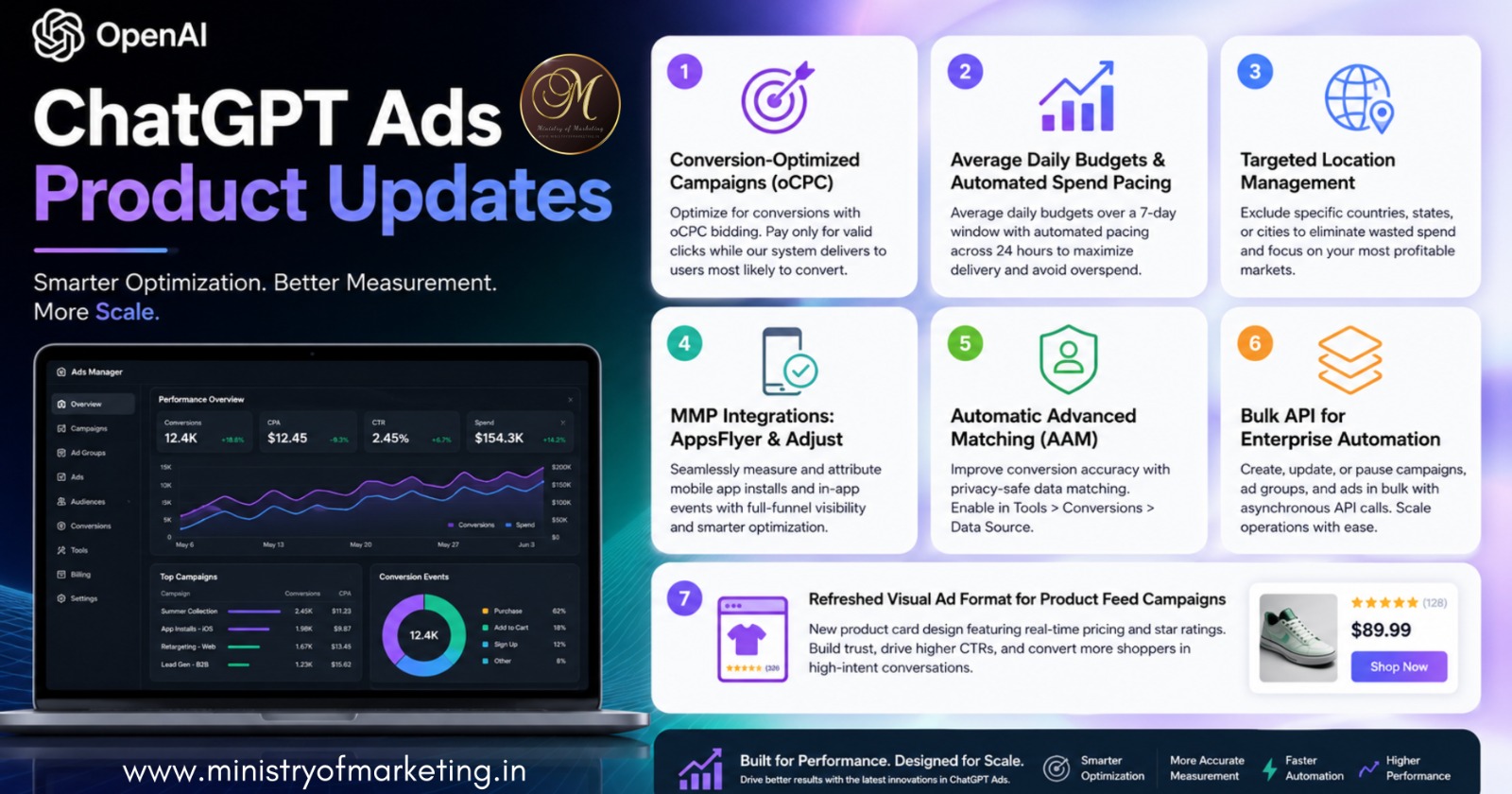
OpenAI ChatGPT Ads Product Updates: Optimizing Conversion, Pacing & Scale
OpenAI’s advertising platform continues to rapidly mature into a core performance channel for digital marketers. The latest wave of platform feature updates focuses directly on giving brands and agencies enterprise-grade controls: optimising toward specific conversion goals, refining cross-platform measurement, balancing daily budget pacing, and streamlining large-scale campaign operations.
Whether you are managing performance campaigns for e-commerce, mobile applications, or B2B lead generation, here is a detailed breakdown of every new feature released in OpenAI’s Ads Manager and how to leverage them for maximum return on ad spend (ROAS).
1. Conversion-Optimized Campaigns (oCPC Bidding)
Performance marketing relies on delivering ad impressions to users most likely to take action. Advertisers can now set up conversion-optimised cost-per-click (oCPC) campaigns directly in the campaign creation workflow.
-
How It Works: By selecting Conversions as your primary Campaign Objective, the ad delivery system dynamically adjusts auction bids and impression distribution toward users who demonstrate a higher probability of completing your defined conversion event.
-
Billing Model: Billing remains securely tied to valid clicks (CPC), providing performance marketers with a risk-mitigated bidding model where you only pay when users engage with your ad asset while benefiting from conversion-weighted delivery algorithms.
2. Average Daily Budgets & Automated Spend Pacing
To prevent campaign underspending or premature budget depletion during early morning hours, daily budget mechanisms and delivery algorithms have undergone two fundamental upgrades:
-
Average Daily Budget Standard: Daily budgets are transitioning from rigid daily hard caps to Average Daily Budgets. The system now evaluates your target spend over a rolling 7-day average window. On days with heightened user traffic or elevated conversion intent, daily spend may fluctuate above your baseline, while remaining strictly bound within weekly limits.
-
Automated Intra-Day Spend Pacing: Daily budgets now pace automatically across a 24-hour cycle. Instead of exhausting funds early in high-volume time frames, the pacing algorithm distributes your budget evenly across the day to ensure persistent brand presence throughout varied user research windows.
3. Targeted Location Management: Geographic Exclusions
Eliminate wasted ad spend by excluding specific regions, states, or cities from your targeting profiles.
-
Operation & Compliance Control: Advertisers can explicitly exclude geographic areas where they do not operate, face regulatory constraints, or experience lower supply chain profitability.
-
Strategic Application: Pair geographic inclusions with localised negative exclusions to prevent ad delivery in non-serviced regions, dramatically sharpening audience alignment and reducing lead churn.
4. Mobile Measurement Partner (MMP) Integrations: AppsFlyer & Adjust
Mobile app advertisers can now seamlessly measure, attribute, and optimise campaign performance across mobile ecosystems through native MMP integrations with AppsFlyer and Adjust.
-
In-App Attribution: Attribute mobile app installs, trial starts, in-app purchases, and custom re-engagement events back to specific ChatGPT Ads campaigns.
-
Smarter Optimisation: Passing post-install telemetry back into OpenAI’s campaign manager allows performance teams to run conversion-optimised app install campaigns with verified downstream event tracking.
5. Automatic Advanced Matching (AAM) for Conversion Accuracy
To combat signal degradation caused by privacy updates and cookie depreciation, Automatic Advanced Matching (AAM) enhances website conversion attribution accuracy.
-
How It Works: AAM securely hashes customer data (such as email addresses or phone numbers) at the point of conversion on your website and matches it against ad interaction signals.
-
How to Enable AAM:
-
Navigate to Tools in Ads Manager.
-
Click on Conversions, then select Data Source.
-
Toggle ‘Enable for all Web data sources’ at the top of the management dashboard.
-
6. Bulk API for Enterprise Automation
Managing complex campaign structures across multiple ad groups, catalogue feeds, or client accounts is now significantly faster via asynchronous programmatic execution.
-
Asynchronous Processing: The new Bulk API capability allows performance engineers and agencies to create, update, or pause campaigns, ad groups, and individual ad creative sets in bulk within a single request.
-
Reduced Friction: By drastically cutting down API call thresholds and eliminating manual dashboard tasks, enterprise teams can programmatically deploy dynamic ad updates at scale.
7. Refreshed Visual Ad Format for Product Feed Campaigns
For retail and direct-to-consumer (D2C) brands running catalogue-based ads, OpenAI is rolling out an updated, high-converting product card UI.
-
Enhanced Social Proof & Pricing: The refreshed product card layout highlights real-time product pricing alongside star rating social proof directly within the interactive card.
-
Higher CTR Potential: Displaying transparent pricing and trust metrics in high-intent conversational contexts gives retail shoppers immediate visual validation before clicking through to product landing pages.
Technical FAQs: Deep Dive into Platform Updates
Q1: What is the core technical difference between standard CPC and the new oCPC bidding model in ChatGPT Ads?
Standard CPC bids linearly across auction loops purely to secure clicks based on raw targeting. The oCPC model uses ML conversion likelihood scoring to adjust bids in real-time toward users with high conversion probability, while maintaining billing strictly on valid user clicks.
Q2: How does the new 7-day Average Daily Budget mechanism handle spend spikes?
The algorithm allows daily spend to exceed your nominal daily budget cap on high-opportunity days (e.g., periods of elevated intent or lower competition). However, the system enforces a strict rolling 7-day expenditure cap, ensuring your total weekly spend equals your daily budget multiplied by seven.
Q3: How does automated spend pacing prevent early budget depletion in ChatGPT Ads?
Pacing algorithms evaluate intra-day traffic patterns and historical conversion rates across 24-hour cycles. Instead of entering every valid auction immediately, the system throttles bid entry programmatically to distribute ad delivery evenly throughout the entire day.
Q4: Does enabling Automatic Advanced Matching (AAM) create privacy compliance or GDPR issues?
No. AAM hashes user identifiers (such as email addresses or phone numbers) locally in the user’s browser using SHA-256 cryptographic algorithms before transmitting them to the server, ensuring raw personally identifiable information (PII) is never shared.
Q5: How do I programmatically configure geographic exclusions via API?
Within your ad group payload, populate the location_targeting object with an excluded_locations array containing valid ISO country codes, state/region IDs, or targeted canonical location keys.
Q6: How do AppsFlyer and Adjust attribute in-app events back to ChatGPT Ads campaigns?
MMP integrations use server-to-server (S2S) API endpoints or probabilistic/deterministic matching frameworks. When a user clicks an ad, a unique click identifier (click_id) is passed to the store URL, which the MMP SDK captures upon app launch and posts back to OpenAI’s attribution endpoints.
Q7: What technical advantage does the Bulk API offer over standard REST endpoints?
Standard REST endpoints require synchronous execution per request, leading to rate limits when updating thousands of ad sets. The Bulk API processes multi-entity creation, update, and deletion tasks asynchronously in a single batch file request.
Q8: How is the Bulk API structured for asynchronous payload execution?
Advertisers submit a multipart POST request containing a bulk payload file (JSON or CSV). The API returns ajob_id, which performance engineers poll via a status endpoint until the job status returns COMPLETED alongside a summary of applied mutations and batch errors.
Q9: Where does the refreshed Product Feed Card pull star ratings and pricing data from?
The UI extracts parameters directly from your connected catalogue feed fields—specifically the price attribute (including ISO currency codes) and the product_rating or microdata schema markup parsed during feed synchronisation.
Q10: Does setting up oCPC require a minimum historical conversion threshold?
While campaigns can launch immediately under the Conversions objective, the underlying machine learning model optimises most efficiently once the tracking pixel logs a baseline of historical conversion events within a 7-day attribution window.
Q11: How do I verify that Automatic Advanced Matching (AAM) is receiving hashed signals correctly?
Navigate to Tools > Conversions > Data Source, select your active Web Data Source, and open the Event Diagnostics tab. Check for the advanced_matching_status flag and ensure parameters like em (hashed email) show active match rates.
Q12: Can geographic exclusions be applied at both the Campaign and Ad Group levels?
Geographic exclusions are defined at the Ad Group level, allowing performance teams to build hyper-specific regional campaigns (e.g., targeting an entire country in Ad Group A while excluding specific states or postal codes in Ad Group B).
Q13: Will the 7-day Average Daily Budget change affect active campaign budgets automatically?
Yes. The platform transitions fixed daily limits to average daily budgets automatically without requiring manual campaign edits or budget re-allocations, maintaining your overall 7-day budget ceiling.
Q14: How does ChatGPT Ads handle invalid clicks or bot traffic in oCPC campaigns?
The platform employs automated click-filtering systems that analyse IP reputations, user-agent headers, and interaction cadence. Clicks flagged as invalid are automatically scrubbed from reporting and credited back before billing.
Q15: Can I track custom offline conversions using the new data matching tools?
Yes. Offline conversion events (such as CRM status updates or phone sales) can be uploaded via the Conversions API or CSV bulk uploader using SHA-256 hashed identifiers to match offline sales back to impression data.
Q16: What happens if an MMP postback fails during a mobile app campaign?
MMPs enforce automated retry policies with exponential backoff algorithms. If a postback fails, the MMP retries transmission over 24 hours to ensure conversion telemetry reaches OpenAI’s optimisation engines.
Q17: How does product feed synchronisation handle real-time inventory and price changes?
Catalogues configured via scheduled SFTP transfers or direct API integrations automatically update item attributes. The refreshed product cards read updated pricing and availability fields directly from the synchronised index.
Q18: What attribution windows are available for oCPC conversion tracking?
By default, the platform supports standard 1-day or 7-day click attribution windows, allowing advertisers to align optimization modeling with their specific sales cycle duration.
Q19: How do I handle rate limits when polling the Bulk API status endpoint?
Engineering workflows should implement exponential backoff strategies when querying job_id statuses (e.g., polling every 5 seconds initially, then scaling interval polling to 15 or 30 seconds for massive batch jobs).
Q20: How do these updates integrate with broader AI discovery strategies like GEO and AEO?
Paid campaign parameters (like structured product feed schema and AAM signals) align with your organic Generative Engine Optimisation (GEO) and Answer Engine Optimisation (AEO) frameworks. Unifying paid catalogue metadata with organic schema ensures consistent brand sentiment across conversational discovery engines.
Partner with an Enterprise Growth Agency
Navigating the rapid release of new generative advertising tools requires a technical partner capable of uniting performance media, advanced schema engineering, and conversion rate optimisation.
As a performance pioneer in AI-driven search and conversion frameworks, Ministry of Marketing helps enterprise brands and high-growth businesses deploy automated ad workflows, leverage custom API setups, and scale market share across digital ecosystems. Explore unified performance strategies today at www.ministryofmarketing.in.