Kriti Sanon Rakhi Ad Controversy: Why Are Women Still Being Told What to Wear?
Kriti Sanon’s Raksha Bandhan advertisement controversy has sparked a much larger conversation than just fashion. It has raised questions about women’s clothing, Indian culture, personal freedom, social judgement and the double standards women continue to face.
A Raksha Bandhan advertisement featuring Bollywood actress Kriti Sanon recently became the centre of a nationwide social media debate not because of its jewellery or its message, but because of what Kriti was wearing.
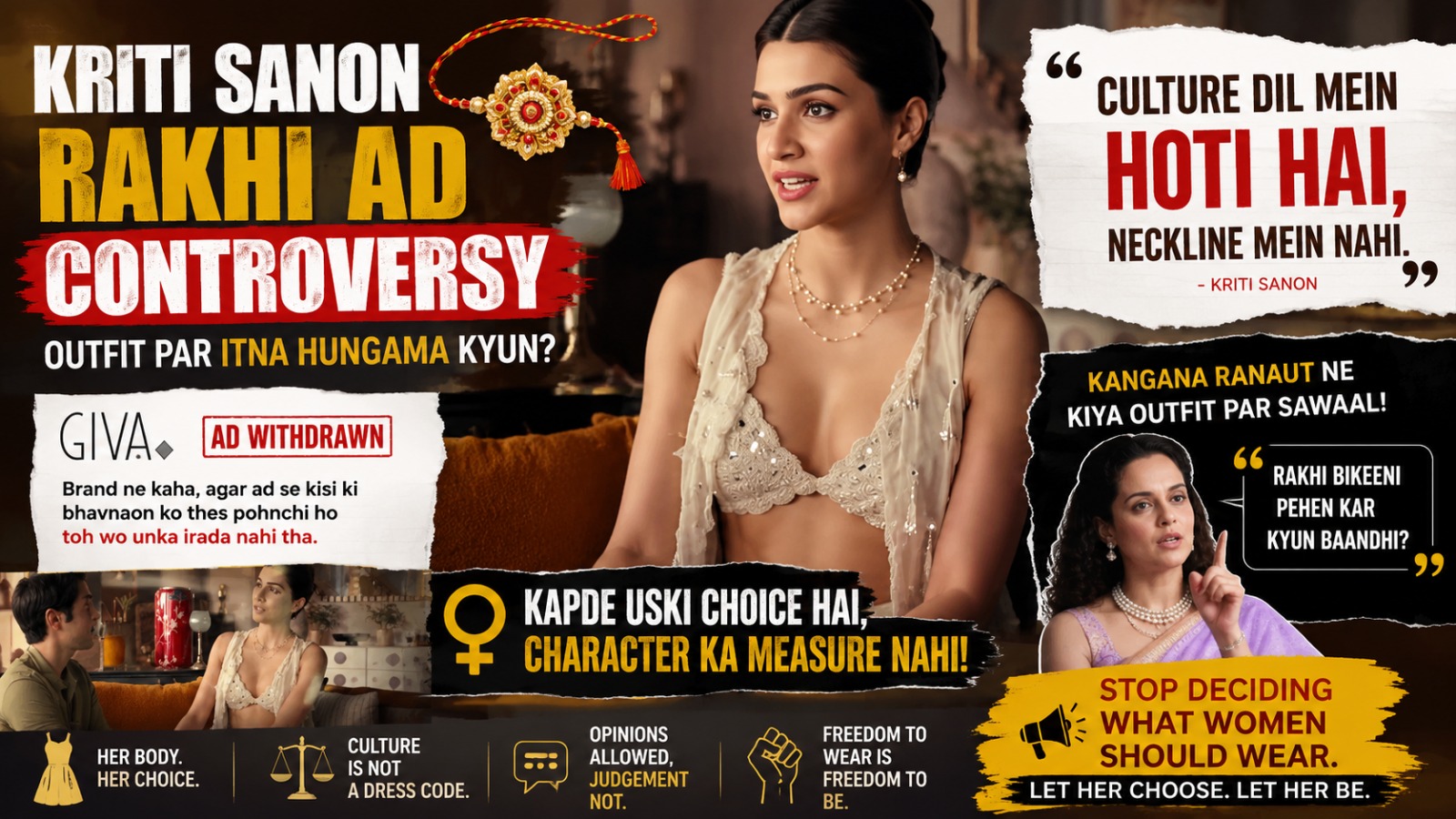
The advertisement for jewellery brand GIVA featured Kriti in an Indo-Western outfit consisting of a bralette-style blouse, cape and draped skirt. A section of social media users criticised the outfit as inappropriate for a festival like Raksha Bandhan. The backlash intensified after actress and BJP MP Kangana Ranaut publicly questioned Kriti’s choice of clothing.
Eventually, GIVA withdrew the advertisement from its media platforms and said that it had the highest regard and deep respect for Indian culture, traditions and festivals. The brand said that if the advertisement had inadvertently hurt the sentiments of some sections of society, that was not its intention.
But beneath the controversy lies a much bigger question:
Why Should Anyone Decide What a Woman Should Wear?
This is where the Kriti Sanon Rakhi ad controversy becomes more than a Bollywood news story.
It becomes a conversation about choice.
Why is a woman’s clothing so often treated as a reflection of her character, values or respect for culture?
If a woman wears a saree, she may be described as traditional.
If she wears a lehenga, she may be considered festive.
But when she chooses a modern or revealing outfit, the conversation can suddenly shift towards morality, culture and “appropriateness.”
The question is not whether everyone has to like an outfit.
Of course, people are allowed to have opinions about fashion.
The bigger question is whether those opinions should become a measure of a woman’s character or determine what she is allowed to wear.
What Was Considered “Vulgar” by Some Was Simply Fashion to Others
The Kriti Sanon outfit became the biggest talking point of the advertisement.
Some viewers saw it as unsuitable for Raksha Bandhan.
Others saw exactly the opposite: a modern, stylish and playful interpretation of a traditional festival campaign.
And that difference in perception matters.
Because vulgarity is not always an objective measurement.
What one person considers inappropriate, another person may simply consider fashionable.
Kriti herself responded to the criticism by questioning why society continues to tell women what to wear. She argued that culture and traditions are held in the heart, rather than being defined by a woman’s neckline.
That statement touches the heart of the debate.
Does Clothing Decide How Much You Respect Your Culture?
Raksha Bandhan is fundamentally about relationships.
It celebrates the bond between siblings.
It is about affection, memories, family and tradition.
So does the emotional meaning of Raksha Bandhan disappear because a woman is wearing a contemporary outfit?
Does a saree make someone more respectful?
Does a traditional outfit automatically make someone more connected to Indian culture?
And does wearing western clothing automatically mean someone has rejected tradition?
Of course not.
Culture is much bigger than clothing.
Culture exists in our relationships, values, language, traditions, food, celebrations and the way we treat one another.
A woman’s blouse cannot define how much she loves her family.
A neckline cannot measure someone’s respect for a festival.
And the number of inches of fabric someone wears cannot determine their character.
Kriti Sanon vs Kangana Ranaut: What Is the Real Debate?
Kangana Ranaut’s criticism added another dimension to the controversy. She questioned why someone would tie Rakhi to her brother while wearing what she described as a bikini-like outfit. Her comments intensified the already growing online debate.
But the important point is not simply Kangana versus Kriti.
Reducing the entire story to a celebrity feud misses the larger issue.
The real discussion is about the line between cultural sensitivity and personal freedom.
Yes, brands should understand the cultural context of festivals when creating advertising campaigns.
Yes, audiences are entitled to critique advertising.
But there is also a difference between saying:
“I don’t think this styling works for a Raksha Bandhan campaign.”
and saying:
“A woman should not be allowed to wear this.”
One is an opinion.
The other becomes controlled.
Why Do Women’s Clothes Become a Public Debate?
This is not the first time a woman’s clothing has become a national conversation.
Actresses, influencers, athletes and ordinary women regularly face judgement over what they wear.
Too traditional.
Too western.
Too revealing.
Too short.
Too tight.
Too modern.
Too “bold.”
The standard keeps changing.
And that is precisely the problem.
Women are often expected to dress according to the comfort level of everyone around them.
But shouldn’t the person actually wearing the clothes have the strongest say?
If she feels comfortable, confident and happy, why does society need to approve her outfit?
The Double Standard Around Women and Clothing
There is another uncomfortable part of this conversation.
Women are frequently told to be confident and independent.
They are encouraged to express themselves.
They are told that they have the freedom to make their own choices.
But when that choice doesn’t match society’s expectations, the judgement begins.
This creates a contradiction:
“You are free to choose but choose what we think is appropriate.”
That isn’t complete freedom.
That is conditional freedom.
And the Kriti Sanon Raksha Bandhan controversy has once again brought that contradiction into the spotlight.
Can Tradition and Modern Fashion Coexist?
Absolutely.
Indian culture itself has evolved constantly.
Fashion has changed.
Wedding clothing has changed.
Festival styling has changed.
The way young Indians celebrate festivals has changed.
And yet, traditions continue.
Modern fashion does not automatically erase culture.
A woman can love her traditions and still wear contemporary clothes.
She can celebrate Raksha Bandhan and still dress in a way that reflects her personal style.
The two ideas do not have to be opposites.
The Bigger Lesson From the Kriti Sanon Controversy
Perhaps the most important takeaway from this entire episode is that we need to separate personal choice from personal judgement.
You don’t have to like Kriti Sanon’s outfit.
You don’t have to think the styling was perfect for the campaign.
You are allowed to criticise the advertisement.
But a woman’s right to choose what she wears should not depend on whether everyone approves of that choice.
Because at some point, the conversation has to move beyond:
“What was she wearing?”
and towards:
“Why do we believe we have the right to decide what she should wear?”
The outfit that some people considered vulgar was, to others, simply cute, stylish, modern and confident.
And perhaps that is the real lesson.
A woman’s clothes can be debated.
Her fashion can be criticised.
But her choice should still belong to her.
Culture does not live in a neckline.
Culture lives in the heart.
And respect should never be measured by how much fabric a woman wears.
_________________________________________________________________________________________________________________________________________
Kriti Sanon Rakhi ad controversy • Kriti Sanon Raksha Bandhan ad • Kriti Sanon outfit controversy • Kriti Sanon GIVA ad • Kriti Sanon Rakhi advertisement • Kriti Sanon Kangana Ranaut controversy • Kangana Ranaut Kriti Sanon • Kriti Sanon latest controversy • Kriti Sanon news • Raksha Bandhan ad controversy • GIVA Raksha Bandhan ad • GIVA ad controversy • Kriti Sanon viral news • Kriti Sanon outfit • women clothing controversy India • women freedom of choice • women right to choose what to wear • women clothing and culture • Indian culture and women’s clothing • women fashion choice • Bollywood controversy • Bollywood latest news • Raksha Bandhan controversy • celebrity outfit controversy • women empowerment India • double standards for women • freedom of expression • personal choice women • fashion and Indian culture