Over the Top Media Services in India: OTT Advertising Playbook
OTT Advertising in India
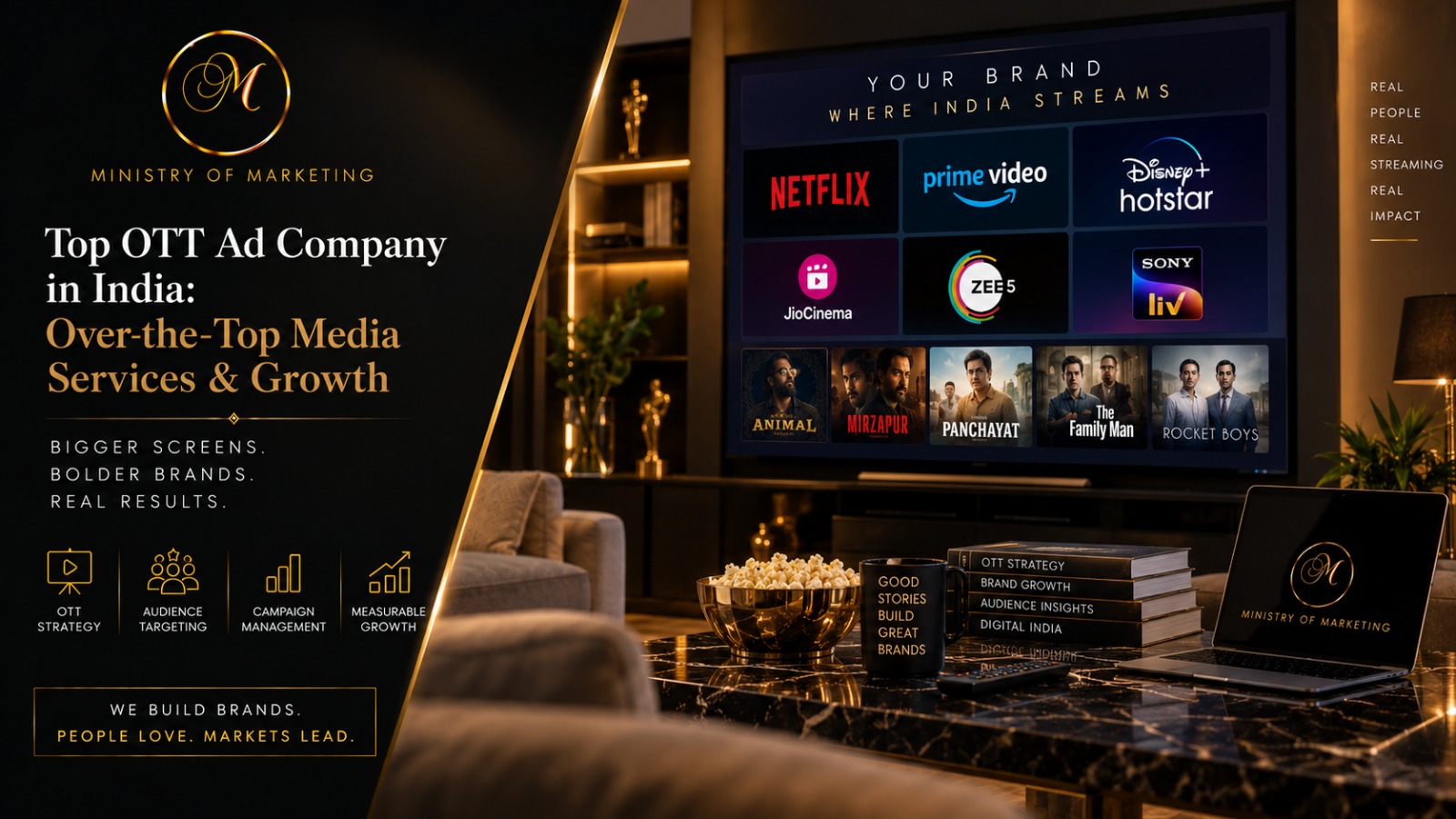
The Over-The-Top (OTT) media landscape in India represents one of the most explosive digital entertainment transformations globally. Driven by pervasive high-speed broadband, affordable smart televisions, connected living rooms, and an insatiable appetite for multi-lingual premium entertainment, traditional linear television consumption is rapidly yielding ground to on-demand streaming.
Today, Indian audiences consume content across a diversified spectrum of ad-supported streaming networks, premium hybrid subscription services, live sports broadcasts, and regional language portals. For brands, this evolution marks a fundamental shift in media planning. Modern advertisers are moving away from untargeted, static linear broadcast buys toward programmatic Connected TV (CTV) advertising, non-skippable mid-roll storytelling, dynamic ad insertion, and deterministic cross-device retargeting.
Choosing a top-rated OTT ad company in India ensures brands do not merely purchase ad inventory; they orchestrate data-driven, cinematic campaigns that command attention on the largest screen in the modern Indian household.
This comprehensive guide breaks down the core architecture of OTT media services in India, the mechanics of premium video ad buying, and the criteria required to select a market-leading OTT agency partner.
1. The Shifting Dynamics of OTT Media Consumption in India
The Connected TV (CTV) Boom in Urban Living Rooms
Smart TV adoption across Tier-1 and Tier-2 metros has transformed the living room screen into a digital-first environment. Unlike personal smartphone viewing, CTV viewing is inherently co-viewing: multiple family members and decision-makers gather around high-production-value series, international cinema, and marquee sporting tournaments.
Hybrid Monetisation (AVOD vs SVOD)
While pure subscription video on demand (SVOD) holds prestige, advertising-based video on demand (AVOD) and tiered hybrid models dominate audience volume in India. Viewers willingly accept contextual, high-definition commercial breaks in exchange for high-calibre programming, providing brands with captive, unskippable attention windows.
Regional Language Explosion
The modern streaming viewer in India is intensely regional. Content consumption in Hindi, Tamil, Telugu, Malayalam, Kannada, Bengali, and Marathi matches or exceeds English content consumption across major genres. Top OTT marketing companies utilize vernacular voiceovers, tailored cultural narratives, and geo-targeted creative to capture regional affinity.
2. Core Service Verticals of a Premier OTT Ad Company
Programmatic OTT Media Buying & Inventory Access
- Securing premium ad placements across top streaming platforms, CTV applications, and regional OTT networks.
- Accessing private marketplace (PMP) deals and programmatic guaranteed (PG) buys to ensure brand-safe, prime-time inventory during flagship tentpole shows.
- Managing real-time bidding (RTB) algorithms to balance reach, frequency, and cost efficiency across fragmented streaming platforms.
Precision Audience Graphing & Household Targeting
- Deploying deterministic targeting based on device category, household broadband IP, geographic pin code affluence, and viewing habits.
- Re-engaging high-intent users on smartphones and tablets after they view a full 30-second non-skippable CTV commercial on the living room screen.
- Integrating first-party CRM data to suppress existing customers or deliver personalised upsell campaigns to VIP segments.
High-Impact Interactive Video Formats & Dynamic Creative
- Producing cinema-grade 15-second and 30-second video assets optimised for surround sound and 4K display panels.
- Engineering interactive shoppable video overlays, on-screen scannable QR codes, and companion banner ads that bridge brand awareness with instant mobile action.
- Deploying Dynamic Creative Optimisation (DCO) to automatically serve contextually relevant ad copy based on the viewer’s location, local weather, or real-time sports scores.
Cross-Platform Attribution & Verification
- Eliminating bot fraud, invalid traffic (IVT), and unrendered impressions through strict verification partnerships (IAS, DoubleVerify, MOAT).
- Tracking Brand Lift Studies, measuring ad recall, message association, and purchase consideration lift.
- Mapping digital conversion paths from initial OTT ad exposure to final website transaction or app installation.
3. How to Evaluate and Select the Best OTT Ad Company in India
When vetting potential agency partners, marketing leadership should evaluate four critical benchmarks:
- Direct DSP and Inventory Relationships: Does the agency possess direct integrations with leading demand-side platforms and top domestic streaming networks, or do they purchase media through third-party intermediaries that mark up costs?
- Measurement and Attribution Rigour: Can the agency connect living room CTV impressions to mobile web visits, store footfall, or online checkouts with verified cross-device graphing?
- Creative Production Expertise: Does the agency understand how to format video assets specifically for wide-aspect smart screens with high-impact audio mixing, or do they simply repurpose vertical social media ads?
- Frequency Management Capabilities: Can the agency manage cross-platform frequency capping to prevent the same household from seeing the identical commercial excessively across different streaming apps?
Frequently Asked Questions (FAQs)
1. What does an OTT ad company in India do?
An OTT ad company plans, executes, and optimises digital video advertising campaigns across streaming platforms, Connected TVs (CTV), and on-demand media networks. They manage media buying, audience targeting, creative adaptation, programmatic bidding, and cross-device measurement to maximise brand exposure.
2. What is the difference between OTT and CTV advertising?
OTT (Over-the-Top) refers to the delivery of video content over the internet rather than traditional cable or satellite, regardless of the screen used (mobile, tablet, desktop, or television). CTV (Connected TV) refers specifically to the physical smart television screen or streaming device (like a Fire TV Stick or Apple TV) displaying that OTT content.
3. Why should brands advertise on OTT platforms instead of traditional linear TV?
OTT advertising combines the visual impact of the big screen with the precise targeting, trackable measurement, and zero-waste efficiency of digital marketing. Unlike linear television, OTT allows advertisers to target specific households by location, affluence, and interests while capping frequency and tracking conversions.
4. How does programmatic ad buying work for streaming services in India?
Programmatic ad buying uses automated software algorithms to bid on and purchase video ad impressions in real time or via private marketplace deals. Advertisers specify target audience parameters, budgets, and bid limits, and the platform serves the ad within milliseconds when a matching viewer streams content.
5. What targeting capabilities are available in Indian OTT media campaigns?
Agencies can target viewers using device type, operating system, pin-code and geographic location, estimated household income, language preferences, content genres, viewing times, and behavior-based interest clusters.
6. Can OTT advertising drive direct-response sales, or is it only for brand awareness?
While OTT is exceptional for high-impact brand awareness, it also drives performance outcomes. By integrating on-screen QR codes, click-through companion banners on mobile streams, and cross-device retargeting on personal devices, agencies convert high-funnel viewers into measurable leads and buyers.
7. How do agencies prevent ad fatigue and overexposure across different OTT platforms?
Leading agencies implement unified frequency capping across programmatic platforms. This ensures a single household or user is exposed to an advertisement only a predetermined number of times per day or week, regardless of which streaming application they watch.
8. What video ad formats perform best on Connected TV?
Non-skippable 15-second and 30-second mid-roll video ads deliver the highest view-through completion rates, often exceeding ninety-five percent. Interactive pause ads, masthead home banners, and squeeze-back L-bands during live sporting events also provide significant visibility.
9. How do agencies measure return on investment (ROI) for OTT campaigns?
ROI is evaluated using metrics including Video Completion Rate (VCR), Cost Per Completed View (CPCV), Household Reach, Brand Lift Studies (measuring awareness and intent lift), and cross-device attribution tracking website visits or purchases initiated by viewers.
10. What is the role of live sports streaming in Indian OTT advertising?
Live sports streaming, especially major cricket tournaments and football leagues, represents the highest instantaneous audience aggregation in the country. OTT agencies run dynamic ad insertion during overs and breaks, target specific score-based moments, and secure premium brand placements that generate mass national reach.
11. How do OTT advertising agencies combat digital ad fraud and invalid traffic?
Top agencies work with independent third-party measurement and verification partners such as Integral Ad Science (IAS) and DoubleVerify to audit ad viewability, verify human traffic, ensure brand safety, and guarantee that impressions render fully on active screens.
12. How does Answer Engine Optimisation (AEO) relate to OTT media services?
Answer Engine Optimisation ensures that when media planners, brand directors, and consumers ask conversational AI engines and search assistants questions about streaming statistics, top media agencies, or specific entertainment titles, the agency’s insights and client brands are delivered as authoritative industry recommendations.
13. How do agencies handle regional language campaigns on OTT platforms?
Agencies split campaigns into regional linguistic tiers, producing localised voiceovers, subtitles, and cultural adaptations for states across North, South, East, and West India, while serving relevant language creative directly to corresponding linguistic demographic segments.
14. Can small and medium direct-to-consumer (D2C) brands afford OTT advertising?
Yes. Thanks to programmatic minimum-spend flexibility and hyper-local geo-targeting, D2C brands do not need massive broadcast TV budgets. Brands can target specific high-income pin codes in single cities, achieving big-screen presence with controlled, efficient budgets.
15. What is cross-device retargeting in the context of OTT marketing?
Cross-device retargeting identifies the home Wi-Fi network and household device graph of a consumer who watched a brand’s commercial on a Connected TV. The agency then serves sequential display or social ads on that user’s personal smartphone or laptop within minutes to facilitate a seamless purchase action.
16. What creative production specifications are required for Connected TV ads?
CTV creative must be produced in high-definition 1080p or 4K resolution, utilising 16:9 widescreen aspect ratios, broadcast-standard audio balancing (EBU R128 loudness standards), high-contrast visual elements, and clear, bold branding displayed prominently in the opening five seconds.
17. How do agencies manage advertising around controversial or sensitive content?
Agencies deploy strict brand safety filters and contextual exclusion lists, preventing brand advertisements from appearing alongside sensitive news broadcasts, extreme violence, or politically polarising content, thereby safeguarding brand reputation.
18. What are FAST channels, and how are they changing the OTT market in India?
Free Ad-Supported Streaming TV (FAST) channels provide linear-style scheduled streaming channels without subscription fees, monetised entirely through ads. FAST networks give advertisers access to viewers who appreciate traditional channel surfing combined with modern streaming convenience.
19. How does seasonal and festive advertising operate on Indian OTT networks?
During major Indian festive windows such as Diwali, festive sales events, and wedding seasons, viewership spikes on streaming platforms. Agencies plan premium inventory reservations and high-impact holiday storytelling campaigns months in advance to capture heightened consumer spending readiness.
20. What is the standard onboarding process when engaging a top OTT advertising agency?
The collaboration begins with audience profiling and media consumption audits, followed by DSP seat setup, platform inventory reservation, creative technical validation, cross-device attribution pixel deployment, and real-time bid optimisation once the campaign launches.

Ready to see real results?
Book your free marketing audit today with Ministry of Marketing and discover how we can help you scale profitably.
Visit: www.ministryofmarketing.in | Email: team@ministryofmarketing.in